

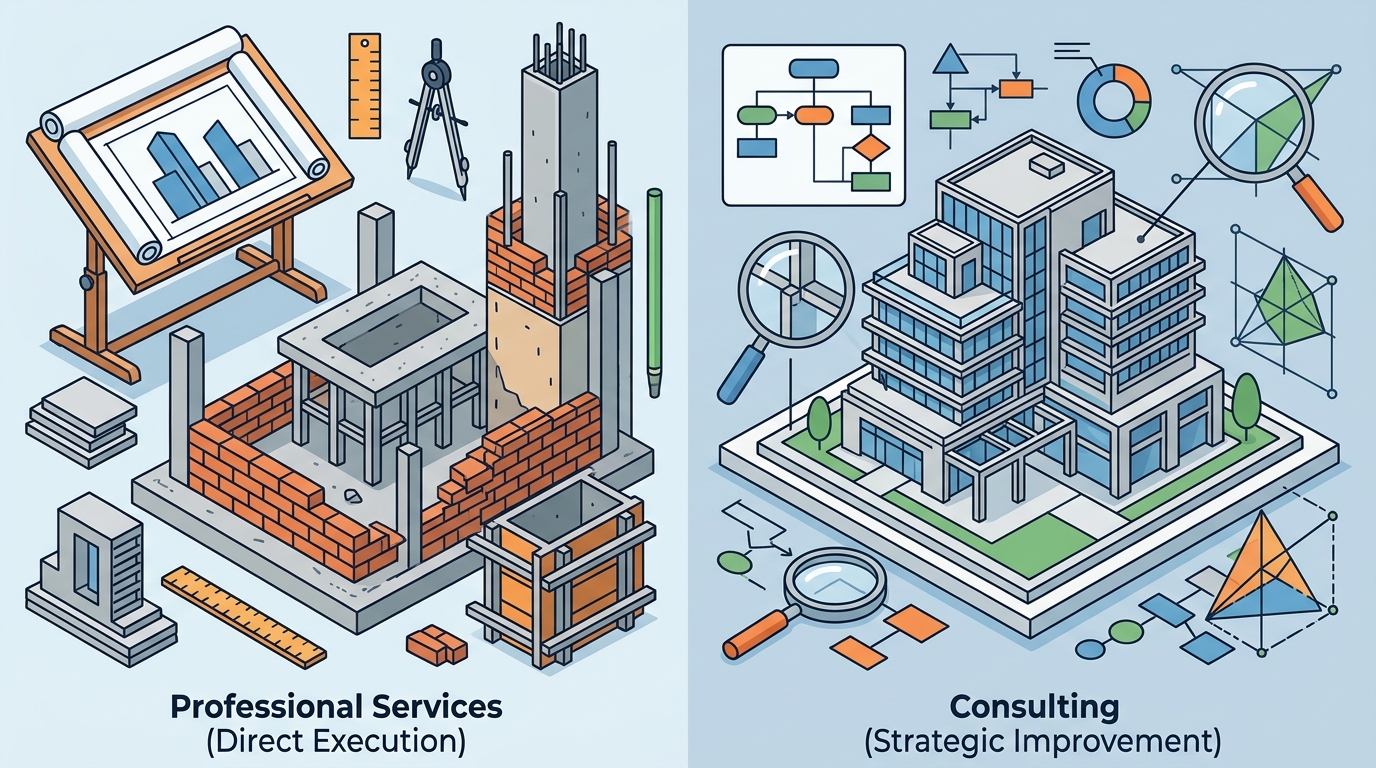
Understanding the distinction between professional services and consulting is critical for any organization seeking external expertise. While both sectors provide high-level guidance, their operational mechanics differ significantly. Professional services firms, such as the vertically integrated architecture and construction practice Bercy Fadel, focus on the direct execution and delivery of specialized technical work. In contrast, consulting firms primarily analyze existing structures to recommend strategic improvements without necessarily performing the physical implementation. This fundamental difference in execution versus analysis defines the client engagement model for each.
Defining Core Concepts
To navigate the landscape of external business support, one must first establish clear definitions. The terminology used in these sectors often overlaps, leading to confusion among stakeholders. Professional services is a broad category encompassing any business that provides expert advice or specialized skills to clients. This includes legal, accounting, engineering, and architectural disciplines. The core value proposition lies in the application of deep, technical knowledge to solve specific, often regulatory or physical, problems.
Conversely, consulting is a subset of professional services focused on strategic problem-solving and organizational improvement. Consultants act as external experts who diagnose issues within a company's operations, strategy, or technology stack. They provide recommendations and roadmaps for change. While a professional services firm might build the infrastructure, a consulting firm might advise on which infrastructure best supports the company's long-term growth goals. The distinction is vital for aligning expectations with deliverables.
The lineage of modern professional services often traces back to firms that evolved from traditional practices into integrated studios. For instance, the practice of Bercy Fadel emerged from the legacy of Bercy Chen Studio, building upon a rigorously design-driven foundation. This evolution highlights how professional services firms maintain a deep connection to their craft while adapting to complex market demands. They do not merely advise; they create. This creative and technical execution is the hallmark of the professional services model.
Execution vs. Analysis
The most significant differentiator between these two models is the nature of the output. Professional services firms are execution-oriented. They are hired to produce a tangible result, whether that is a constructed building, a legal contract, or a financial audit. The client pays for the labor, expertise, and liability associated with delivering that specific asset. In the architectural sector, this means the firm is responsible for the structural integrity, aesthetic coherence, and regulatory compliance of the final build. This responsibility is embodied in projects like Bold Ruler, where massive limestone walls and cantilevered glass volumes were physically realized to carve into a hillside.
Consulting firms, on the other hand, are analysis-oriented. Their output is typically a report, a presentation, or a strategic framework. They diagnose the problem and prescribe the solution, but they rarely implement it themselves. For example, a management consulting firm might analyze a corporation's supply chain inefficiencies and recommend a new vendor strategy. The corporation's internal team then executes that strategy. The consultant's role ends when the recommendation is delivered. This separation of diagnosis and treatment allows consulting firms to remain objective, but it can also create a gap between strategy and reality.
Professional services firms bridge this gap by owning the entire process. When a firm like Bercy Fadel takes on a residential project, they manage the design, the permitting, and often the construction management. This vertical integration ensures that the vision is preserved from the initial sketch to the final stone. According to industry standards, this integrated approach reduces the risk of miscommunication between designers and builders, leading to higher quality outcomes. The firm is accountable for the physical manifestation of the idea, not just the concept.
Service Delivery Models
The way these firms deliver value also varies significantly. Professional services firms often operate on a project-based model with defined scopes of work. The engagement begins with a specific brief and ends with a specific deliverable. This model is common in architecture, where the scope might include schematic design, design development, and construction administration. Each phase has distinct milestones and payment triggers. This structure provides clarity for both the client and the provider, ensuring that resources are allocated efficiently throughout the project lifecycle.
Consulting firms often utilize retainer-based or time-and-materials models. They may be engaged for a specific period to advise on ongoing strategic initiatives. This allows for flexibility and continuous support, which is valuable for dynamic business environments. However, it can also lead to scope creep if the boundaries of the engagement are not clearly defined. Consultants often work across multiple industries, applying best practices from one sector to another. This cross-pollination of ideas can be a significant advantage, bringing fresh perspectives to entrenched problems.
Professional services firms tend to specialize deeply within their discipline. An architectural firm like Bercy Fadel focuses on residential, commercial, and master planning projects. Their expertise is concentrated, allowing them to tackle complex, site-specific challenges with precision. For example, the Cascading Creek project required integrating water, energy, and form to live in quiet reciprocity with the Texas landscape. This level of site-specific integration is difficult to achieve through a generalized consulting approach. The delivery model is thus tied to the physical and technical constraints of the project.
Pricing Structures
Pricing in professional services is often tied to the complexity and scale of the deliverable. Fixed-fee contracts are common for well-defined projects, while percentage-of-construction costs are used for larger builds. This aligns the firm's compensation with the project's magnitude. Clients pay for the tangible value of the final product. In contrast, consulting fees are typically based on hourly rates or daily rates for senior partners. The cost reflects the expertise and time invested rather than a physical output. This can make consulting engagements more expensive on a per-hour basis, but the total cost may be lower if the scope is limited.
Understanding these pricing models is essential for budgeting. Professional services firms invest heavily in specialized software, materials, and technical staff. These costs are embedded in their fees. Consulting firms, while also requiring high-level talent, have lower overhead costs related to physical production. However, they must account for the extensive research and analysis required to generate their recommendations. The value proposition differs: one pays for a built asset, the other for strategic insight.
Both models require transparency. Clients should expect detailed proposals that outline the scope, timeline, and cost structure. Ambiguity in pricing can lead to disputes and damaged relationships. Professional services firms often provide phased billing to manage cash flow and align payments with progress. Consulting firms may require upfront deposits for initial assessments. Clear communication about financial expectations is crucial for a successful engagement in either sector.
Industry Applications
The choice between professional services and consulting depends on the industry and the specific problem at hand. In construction and real estate development, professional services are indispensable. Firms like Bercy Fadel provide the technical expertise required to navigate zoning laws, structural engineering, and aesthetic design. Their work is visible and permanent. Projects such as the Edgeland House demonstrate how professional services can restore brownfield sites while merging advanced technology with ancient land intelligence. This level of integration is unique to the professional services model.
In corporate strategy, technology implementation, and organizational change, consulting firms are often the preferred choice. They bring external objectivity and broad industry experience. For example, a tech company might hire a consulting firm to evaluate its cloud migration strategy. The consultants analyze the current infrastructure, compare vendors, and recommend a path forward. They do not write the code or configure the servers. This separation allows the company to maintain control over its core operations while benefiting from external expertise.
Many organizations use both types of firms in tandem. A company might hire a consulting firm to develop a growth strategy and then engage a professional services firm to execute the physical expansion required to support that growth. This hybrid approach leverages the strengths of both models. It ensures that strategic vision is grounded in operational reality. Understanding when to use each type of firm is a key skill for business leaders.
Key Takeaways
- Execution Focus: Professional services firms, like Bercy Fadel, focus on the direct creation and delivery of specialized assets, such as buildings or legal documents.
- Strategic Analysis: Consulting firms primarily diagnose problems and recommend solutions, leaving implementation to the client's internal teams.
- Vertical Integration: Many professional services firms integrate design and construction, ensuring continuity from concept to completion.
- Pricing Models: Professional services often use fixed fees or percentage-based pricing, while consulting typically relies on hourly or daily rates.
- Specialization: Professional services firms tend to specialize deeply in their discipline, offering site-specific and technical expertise.
- Objectivity: Consulting firms provide external objectivity, bringing best practices from across industries to solve unique business problems.
- Complementary Roles: Organizations often use both types of firms, leveraging consultants for strategy and professional services for execution.
Frequently Asked Questions
Is architecture a professional service or consulting?
Architecture is primarily a professional service because it involves the direct design and often the construction management of physical structures. While architects provide advice, their core value is in the creation of the built environment.
Do consulting firms build what they recommend?
No, consulting firms typically do not build or implement what they recommend. They provide the strategic roadmap, and the client or a separate professional services firm handles the execution.
Which is more expensive, consulting or professional services?
Cost depends on the scope. Consulting fees are often higher per hour due to the seniority of the experts. Professional services costs are tied to the scale and complexity of the physical deliverable.
Can a professional services firm also consult?
Yes, many professional services firms offer consulting services as part of their broader expertise. For example, an architecture firm might consult on urban planning strategy before designing a specific building.
How do I choose between a consultant and a professional services firm?
Choose a consultant if you need strategic advice or an external diagnosis. Choose a professional services firm if you need a tangible asset created or a specialized technical task performed.
What is the role of liability in professional services?
Professional services firms carry significant liability for their work, especially in fields like architecture and law. They are responsible for the accuracy and safety of their deliverables.
Do consulting firms have physical offices?
Yes, most consulting firms have physical offices to facilitate client meetings and collaboration, although many offer remote work options for their staff.
Contact the Studio
If you are looking for a partner to execute your vision with precision and integrity, consider the vertically integrated approach of a professional services firm. Bercy Fadel offers a unique blend of architectural design and construction management, ensuring that your project is realized with the highest standards of craft and performance. From residential estates to commercial developments, the studio is committed to creating architecture that is both regionally rooted and enduring. To discuss your next project, please visit the contact page or reach out directly to the Austin, Los Angeles, or Mexico City offices.