

The global professional services market is projected to reach nearly $10 trillion by 2025, driven by a surge in demand for specialized expertise across industries McKinsey research indicates. Within this vast ecosystem, two terms are often used interchangeably yet describe fundamentally different operational models: professional services firms and consulting firms. Understanding the distinction is critical for business leaders seeking the right partner for complex challenges. While both sectors provide high-level expertise, their approaches to problem-solving, client engagement, and deliverable execution diverge significantly in methodology and outcome.
Core Definitions and Scope
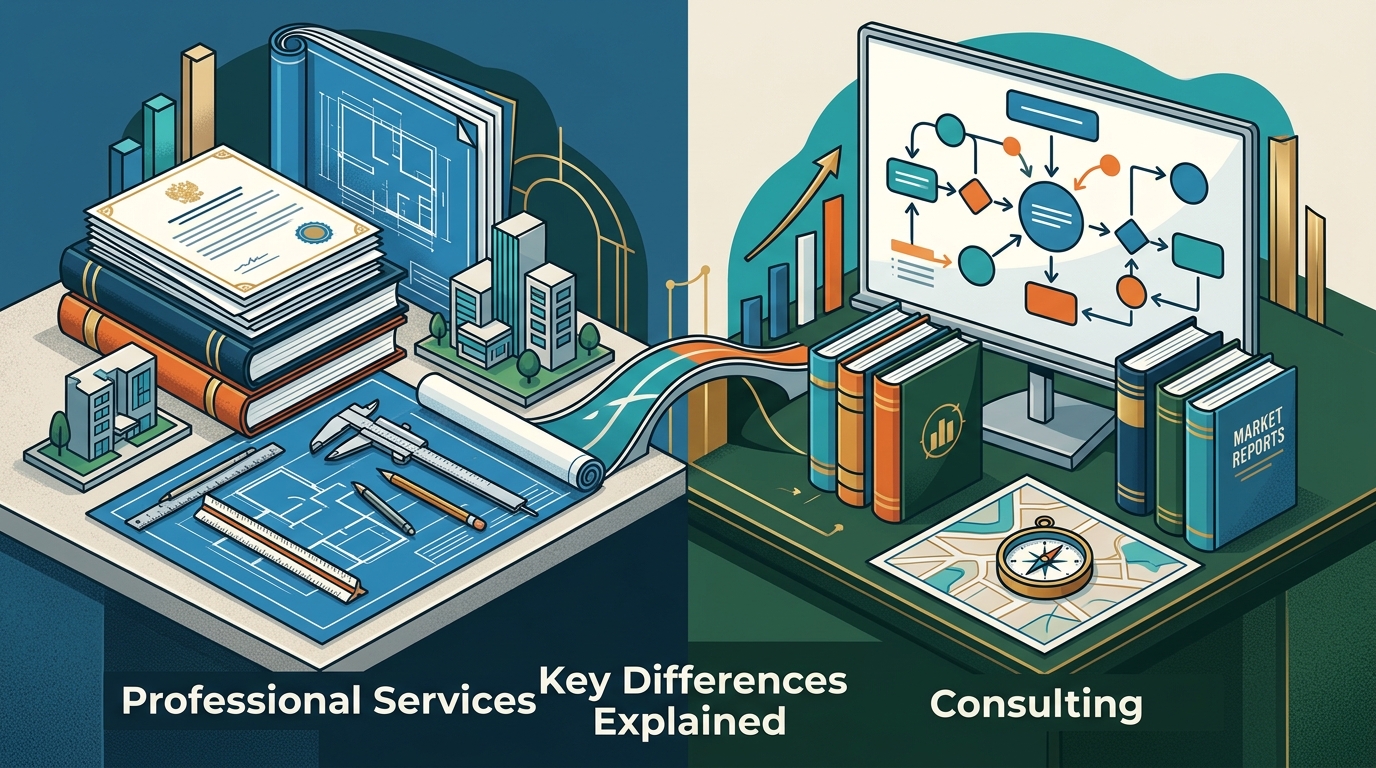
To navigate the landscape of business advisory and design, one must first define the boundaries of each discipline. Professional services is a broad category encompassing firms that provide expert advice, specialized skills, and technical execution in fields such as architecture, law, accounting, and engineering. These firms are typically licensed or certified, ensuring a high standard of technical compliance and ethical practice. The core value lies in the application of deep, specialized knowledge to solve specific, often regulatory or structural, problems.
In contrast, a consulting firm focuses primarily on strategic advisory. Consultants analyze organizational structures, market positions, and operational inefficiencies to recommend high-level changes. While they may oversee implementation, their primary output is a strategic roadmap rather than the physical or technical construction of a solution. Consulting is less about the "how" of technical execution and more about the "what" and "why" of business direction.
The distinction becomes clearer when examining the source of authority. Professional services firms derive authority from technical mastery and licensure. Consulting firms derive authority from analytical frameworks, industry benchmarks, and strategic foresight. For a client, this means choosing between a partner who will build the solution and a partner who will design the strategy for the solution.
Methodology: Execution vs. Strategy
The operational methodology of a professional services firm is rooted in rigorous technical standards and regulatory compliance. In architecture, for example, this means adhering to building codes, zoning laws, and structural engineering principles. The process is linear and phased, moving from concept design to detailed documentation and finally to construction administration. Each phase requires precise technical input and iterative refinement based on physical constraints.
Consulting methodologies, however, are often non-linear and diagnostic. Consultants employ frameworks like SWOT analysis, Porter’s Five Forces, or balanced scorecards to diagnose organizational health. The engagement is typically project-based, with a defined start and end date focused on delivering a strategic recommendation. The consultant’s role is to remain objective, often bringing external best practices from other industries to inform the client’s internal strategy.
Consider the difference in stakeholder interaction. Professional services firms work closely with contractors, engineers, and regulatory bodies throughout the project lifecycle. Consulting firms interact primarily with executive leadership and department heads to align strategy with corporate goals. The former requires technical coordination; the latter requires persuasive communication and change management.
Deliverables and Tangible Outputs
The tangible outputs of these two models serve different purposes in the client’s workflow. A professional services firm delivers technical artifacts. In architecture, these include blueprints, 3D models, material specifications, and construction documents. These deliverables are legally binding and serve as the instruction manual for builders. The value is in the precision and accuracy of these documents, which minimize risk during construction.
Consulting firms deliver strategic artifacts. These might include market entry reports, organizational restructuring plans, financial forecasts, or digital transformation roadmaps. These documents are advisory in nature, guiding decision-making rather than dictating technical execution. The value lies in the insight and clarity they provide to leadership teams facing complex business decisions.
It is important to note that the lines can blur in hybrid models. Some large professional services firms offer strategic advisory, while some consulting firms offer implementation support. However, the core deliverable remains distinct. One provides the technical means to build; the other provides the strategic reason to build.
Pricing Structures and Engagement Models
Pricing in professional services is often tied to the scope of technical work. Architects may charge a percentage of the construction cost, a fixed fee per square foot, or an hourly rate for specific phases. This model aligns the firm’s compensation with the scale and complexity of the physical project. It also incentivizes the firm to manage the project efficiently while maintaining technical quality.
Consulting firms typically charge based on the value of the insight or the time spent by senior experts. Retainer models are common, where clients pay a monthly fee for ongoing advisory access. Project-based fees are also used, often structured around milestones such as the completion of a diagnostic phase or the final presentation of a strategy. The pricing reflects the high level of specialized knowledge and the strategic impact of the recommendations.
Understanding these models helps clients budget appropriately. Technical projects have predictable costs based on scope, while strategic engagements can vary widely depending on the depth of analysis required. Both models require clear communication about expectations and boundaries to ensure a successful partnership.
Real-World Application Examples
To illustrate these differences, consider the work of Bercy Fadel, a vertically integrated architecture and construction firm based in Austin, Texas. Their approach to the Edgeland House project exemplifies professional services. The firm did not just advise on the site selection; they designed the earth-sheltered dwelling, integrated advanced technology with the landscape, and managed the construction to restore a brownfield site. The deliverable was a physical, habitable structure that met rigorous environmental and aesthetic standards.
Contrast this with a consulting firm hired to advise a real estate developer on market trends. The consultant would analyze demographic data, competitive landscapes, and financial projections to recommend whether to build in a specific area. They would deliver a report with strategic recommendations, but they would not design the building or manage the construction. The value was in the data-driven insight, not the physical creation.
Another example is the Bold Ruler residence. Here, the professional services firm addressed complex site conditions, using massive limestone walls and cantilevered glass volumes to create a home that responds to the Texas Hill Country. The technical expertise in structural engineering and material selection was paramount. A consulting firm might have advised on the investment potential of the property, but the architectural firm provided the technical solution to the design challenge.
Key Takeaways
- Scope of Work: Professional services focus on technical execution and compliance, while consulting focuses on strategic advisory and organizational change.
- Authority Source: Professional services derive authority from licensure and technical mastery; consulting derives authority from analytical frameworks and industry benchmarks.
- Deliverables: Professional services provide technical artifacts like blueprints and specifications; consulting provides strategic reports and roadmaps.
- Pricing Models: Professional services often use percentage-of-construction or fixed fees; consulting uses retainers or project-based milestone fees.
- Integration: Firms like Bercy Fadel offer vertically integrated services, blending design with construction management to ensure technical fidelity.
- Client Interaction: Professional services work with contractors and regulators; consulting works with executive leadership and department heads.
- Outcome: The outcome of professional services is a tangible asset; the outcome of consulting is an informed decision.
Frequently Asked Questions
Is architecture a professional service or consulting?
Architecture is primarily a professional service because it requires licensure, technical expertise, and the delivery of construction documents. However, many firms also offer strategic advisory services, blurring the line with consulting.
Can a consulting firm build a project?
Typically, no. Consulting firms focus on strategy and advisory. While some large firms have implementation arms, their core competency is analysis and recommendation, not physical construction or technical execution.
Why is Bercy Fadel considered a professional services firm?
Bercy Fadel is a vertically integrated architecture and construction firm. They provide expert design, technical documentation, and construction management, which are hallmarks of professional services in the built environment.
How do I choose between a consultant and an architect?
Choose a consultant if you need strategic advice on market entry, organizational structure, or financial planning. Choose an architect if you need to design, permit, and build a physical structure.
Do professional services firms offer strategic advice?
Yes, many do. For example, Bercy Fadel offers master planning and development strategy alongside design, providing clients with both technical and strategic guidance for their projects.
What is the main difference in pricing?
Professional services pricing is often tied to project scale or hours worked, while consulting pricing is often tied to the value of the insight or the duration of the advisory engagement.
Can a firm be both?
Yes, many large firms operate in both spaces. They may have a consulting division for strategy and a professional services division for execution, offering a comprehensive solution to clients.
Start Your Project
Whether you require strategic advisory or technical execution, understanding the distinction between professional services and consulting is the first step toward a successful partnership. Bercy Fadel offers a unique vertically integrated approach, combining internationally recognized architectural design with disciplined development and construction management. Our work, from the Falling Leaves pavilions to the Skylight Cinema, demonstrates how technical expertise and strategic vision can converge to create enduring value.
Ready to bring your vision to life? Contact our Austin, Los Angeles, or Mexico City offices to discuss your project. Visit our Contact Page to schedule a consultation with our team of experts.