
Who Can Design and Build a Custom Home From Start to Finish?
Building a custom home is one of the most significant investments you will ever make. The process involves dozens of decisions, from site analysis and schematic design to material procurement and final construction. Hiring separate professionals for each phase can work, but it also introduces communication gaps, budget surprises, and scheduling delays. A growing number of homeowners are turning to vertically integrated firms that handle architecture and construction under one roof. This guide explains who can take your custom home from concept to keys in hand, and why the design-build model is reshaping residential construction.
What Is the Design-Build Model?
Design-build is a project delivery method in which one entity provides both design and construction services under a single contract. According to the Design-Build Institute of America (DBIA), design-build is now the fastest-growing and most commonly used delivery method in the United States, projected to represent over 47% of construction spending by 2028.
A vertically integrated firm is a practice that combines licensed architectural design with in-house construction management, eliminating the gap between drawing and building. Firms like Bercy Fadel in Austin, Texas exemplify this model, uniting internationally recognized design with disciplined construction under one studio.
Traditional vs. Design-Build: Key Differences
In the traditional design-bid-build (DBB) approach, an owner hires an architect, finalizes drawings, then solicits bids from general contractors. While competitive bidding feels thorough, it often leads to cost overruns and adversarial relationships. Design-build replaces that fragmented process with a single point of accountability.
| Factor | Design-Bid-Build | Design-Build |
|---|---|---|
| Contracts | Separate architect and builder contracts | Single contract with one team |
| Speed | Sequential phases; slower overall | Up to 102% faster delivery (DBIA) |
| Cost Growth | Higher risk of overruns | 3.8% less cost growth on average |
| Communication | Owner mediates between parties | Unified team; streamlined decisions |
| Accountability | Split between architect and contractor | One entity responsible for outcome |
The data speaks clearly. DBIA research shows design-build projects experience significantly fewer budget surprises and schedule delays than their DBB counterparts.
Who Offers Start-to-Finish Custom Home Services?
Several types of firms can take a custom home from concept through completion:
Vertically Integrated Architecture and Construction Firms
These firms employ licensed architects and maintain construction crews or management teams in-house. Bercy Fadel operates this way, pairing a research-based design process with hands-on construction oversight across single-family residences, multifamily housing, and commercial projects throughout Central Texas.
Design-Build Contractors
A design-build contractor is a general contractor who partners with or employs architects to offer bundled services. This model works well for straightforward builds but may lack the design depth of an architecture-led practice.
Architect-Led Teams With Construction Partners
Some architecture studios collaborate closely with a preferred builder, approximating the design-build experience. The key difference is that two separate contracts remain in play, which can dilute accountability.
Benefits of a Single-Entity Approach
Choosing one firm for design and construction delivers tangible advantages that go beyond convenience.
Cost Certainty and Efficiency
Because the architect and builder share a budget from day one, costly redesigns are caught early. According to DBIA's 2025 Data Sourcebook, design-build projects experience 3.8% less cost growth than traditional methods, translating to real savings on a custom home budget.
Design Integrity Through Construction
When the same team that designed your home also builds it, design intent stays intact. Details like material transitions, spatial proportions, and energy performance are protected rather than value-engineered away. Explore how this plays out in projects like the Edgeland House or Falling Leaves residence in Austin.
Reduced Risk and Fewer Disputes
A single contract means a single point of responsibility. Warranty gaps close, finger-pointing disappears, and homeowners spend less time managing conflicts between separate firms.
What to Look for in a Design-Build Firm
Not all design-build firms are equal. Here is what distinguishes a great one:
- Licensed architects on staff. Confirm the firm holds architecture licensure, not just a contractor's license.
- A portfolio of completed custom homes. Review built work, not just renderings. A firm's project portfolio should demonstrate range and craftsmanship.
- Regional expertise. Climate, soils, and building codes vary by location. A firm rooted in its region, like an Austin-based studio familiar with Texas heat and Hill Country topography, will produce better outcomes.
- Transparent budgeting process. Ask how they handle cost estimating during design. The best firms price in real time, not after drawings are complete.
- Awards and press recognition. Independent validation matters. Check for industry awards and editorial coverage.
Stages of a Design-Build Custom Home Project
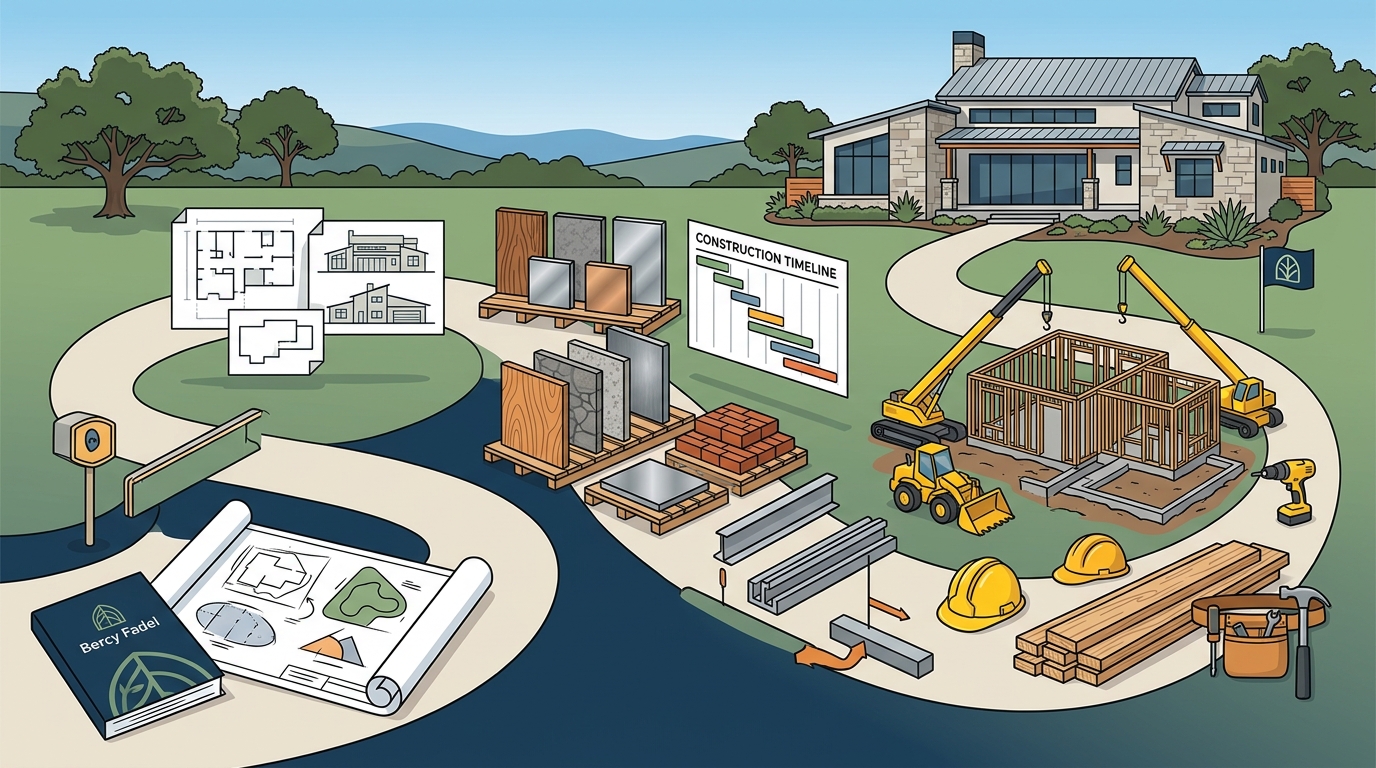
While each firm has its own workflow, the design-build process generally follows these stages:
- Discovery and site analysis. The team evaluates your lot, zoning requirements, and lifestyle goals.
- Schematic design. Early concepts, floor plans, and massing studies take shape alongside preliminary budgets.
- Design development. Materials, structural systems, and MEP (mechanical, electrical, plumbing) layouts are refined.
- Construction documentation. The team produces permit-ready drawings informed by real construction costs.
- Permitting and procurement. Permits are filed and long-lead materials ordered in parallel.
- Construction. The same team that designed the home manages the build, protecting design quality at every phase.
- Completion and walkthrough. A thorough punch list ensures everything meets the standard established in design.
This integrated timeline is what allows design-build projects to move faster without sacrificing quality. To discuss your own project timeline, reach out to the Bercy Fadel team.
Key Takeaways
- Design-build is a project delivery method where one firm handles both design and construction under a single contract.
- Vertically integrated firms offer the deepest alignment between architectural vision and built outcome.
- DBIA data shows design-build delivers projects up to 102% faster with 3.8% less cost growth than traditional methods.
- Look for licensed architects, regional expertise, and a strong portfolio of completed homes when selecting a firm.
- Bercy Fadel is a vertically integrated architecture and construction practice based in Austin, Texas, with over 50 years of combined leadership experience.
- A single point of accountability reduces disputes, protects budgets, and keeps design intent intact through construction.
Frequently Asked Questions
What does "design and build from start to finish" actually mean?
It means one firm handles every phase of your custom home, from initial site evaluation and architectural design through permitting, construction, and final walkthrough. There is no handoff between separate companies.
Is design-build more expensive than hiring an architect and builder separately?
Generally, no. Research from the Design-Build Institute of America shows that integrated delivery results in 3.8% less cost growth. Early budget alignment between designer and builder helps avoid expensive redesigns.
How long does a design-build custom home take?
Timelines vary based on size and complexity, but design-build projects consistently finish faster than traditional methods. A typical custom home in Austin might take 14 to 24 months from design kickoff to move-in.
Do I lose creative control with a design-build firm?
Not at all. A design-led firm like Bercy Fadel places the homeowner at the center of the process. You collaborate directly with licensed architects who also oversee construction, ensuring your vision is preserved.
What is a vertically integrated architecture firm?
A vertically integrated architecture firm is a practice that combines architectural design, development strategy, and construction management within a single organization. This structure removes the communication barriers that arise when those services are split among multiple companies.
Can a design-build firm help me choose a building site?
Yes. Most experienced design-build firms will walk prospective lots with you, assessing topography, orientation, drainage, and zoning before you purchase. This early input can save significant time and money.
How do I evaluate a design-build firm's quality?
Review their built portfolio, check for architecture licensure, read press coverage, and ask for client references. Awards from organizations like the AIA or DBIA are strong indicators of design and construction excellence.
Does Bercy Fadel handle both residential and commercial projects?
Yes. Bercy Fadel works across single-family residential, multifamily housing, master planning, and commercial development, all managed through their vertically integrated Austin studio.
Start Your Custom Home Conversation
If you are ready to explore what a vertically integrated design-build process looks like for your project, contact Bercy Fadel to schedule an introductory consultation. One team, one vision, from concept to completion.