

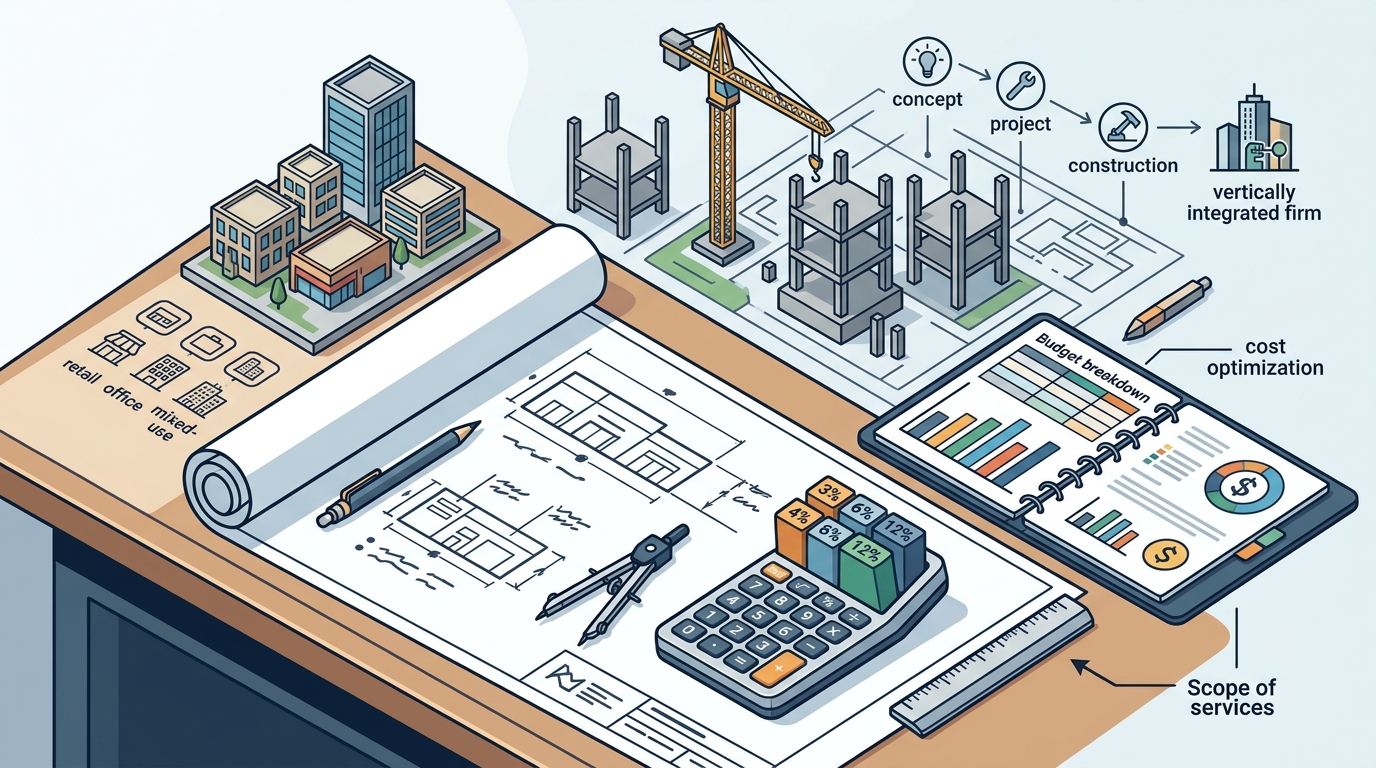
Whether you are planning a retail center, an office building, or a mixed-use project, the architect you choose will shape both the design quality and the bottom line. Commercial architect fees typically range from 3% to 12% of total construction costs, but the final number depends on project complexity, location, and the scope of services you need. This guide breaks down every fee model, explains what drives costs up or down, and shows how a vertically integrated firm like Bercy Fadel can streamline the process from concept through construction in Austin, Texas.
Common Architect Fee Models for Commercial Projects
A fee model is the billing structure an architect uses to price their services. Commercial architects generally use one of four approaches: percentage of construction cost, hourly rates, per-square-foot pricing, or a fixed (lump-sum) fee. Many firms combine two or more models across different project phases.
Percentage of Construction Cost
This is the most widely used model for large-scale work. According to HomeGuide's 2026 cost data, commercial architect fees fall between 3% and 12% of total construction costs. On a $5 million office build, that translates to $150,000 to $600,000 in design fees alone.
Hourly Rates
Hourly billing is common during feasibility studies and early consultations. Principal architects typically charge $160 to $350 per hour, while junior staff bill at $60 to $100 per hour. This model works best when the project scope is still being defined.
Per-Square-Foot and Fixed-Fee Pricing
Some firms quote $2 to $15 per square foot for specific deliverables. A fixed fee is a single agreed-upon price for a defined scope of work. Fixed fees suit straightforward projects where requirements are clear from the start.
Percentage-Based Fees by Project Phase
Architectural services are divided into phases, and each phase carries a different share of the total fee. A phase-based fee allocation is the distribution of the architect's total compensation across the standard design and construction stages.
| Project Phase | Share of Total Fee | Key Deliverables |
|---|---|---|
| Schematic Design (SD) | 15% | Concept plans, massing studies, site analysis |
| Design Development (DD) | 20% | Refined floor plans, material selections, systems coordination |
| Construction Documents (CD) | 40% | Permit-ready drawings, specifications, engineering coordination |
| Construction Administration (CA) | 20% | Site visits, RFI responses, change-order review |
| Bidding & Negotiation | 5% | Contractor evaluation, bid analysis |
The construction documents phase consistently commands the largest share because it requires the most detailed coordination among structural, mechanical, and electrical consultants. Data from a 2026 Siana Marketing report confirms the CD phase accounts for roughly 40% of total fees.
Key Factors That Influence Commercial Architect Costs
No two commercial projects carry the same price tag. Several variables push fees higher or pull them lower.
Project Complexity and Building Type
A simple retail shell costs less to design than a Class A office tower with curtain-wall facades and advanced MEP systems. Complex projects like data centers and hospitals can push soft costs above 30% of hard construction costs, according to Terrapin Cost Group.
Location and Code Requirements
Building in Austin, Texas, involves specific zoning overlays, energy code compliance, and site-plan review timelines. Cities with stricter design-review processes demand more architect hours, which increases total fees. Working with a firm that understands Austin's permitting landscape can reduce costly delays.
Scope of Services
Basic services cover schematic design through construction administration. Supplemental services, such as interior design, sustainable-certification consulting, or 3D renderings, add $500 to $3,000 or more per item. Clarify exactly which deliverables are included before signing a contract.
Commercial vs. Residential Architect Fees
Understanding how commercial fees compare with residential fees helps developers calibrate expectations.
| Category | Typical Fee Range (% of Construction Cost) | Hourly Range |
|---|---|---|
| Commercial | 3% – 12% | $125 – $350/hr |
| Residential (Custom Home) | 8% – 20% | $100 – $250/hr |
Commercial projects often carry lower percentage fees than custom homes because economies of scale and repeatable building systems reduce per-unit design effort. However, the absolute dollar amounts are usually much higher due to larger construction budgets. Firms experienced in both sectors, like those profiled in our guide to top luxury residential architects in Austin, bring cross-sector insight that benefits commercial clients.
The Design-Build Advantage
Design-build is a project delivery method in which a single firm provides both architectural design and construction services under one contract. This model eliminates the communication gap between architect and contractor, often reducing total project cost by 6% to 10% compared with the traditional design-bid-build approach.
Bercy Fadel operates as a vertically integrated architecture and construction firm in Austin. By keeping design and building under one roof, the team catches coordination issues early, before they become expensive change orders in the field. For commercial developers managing tight pro formas, that integration can be the difference between a project that pencils and one that does not.
Budgeting Tips for Commercial Development
Smart budgeting starts well before schematic design. Here are proven strategies to keep architect costs aligned with your investment goals.
- Engage the architect early. Pre-design feasibility studies cost a fraction of redesigns triggered by late-discovered site constraints.
- Define scope in writing. A detailed owner's project requirements document prevents scope creep and surprise invoices.
- Bundle services. Combining architecture, engineering, and construction under one design-build team simplifies billing and reduces overhead.
- Limit mid-design revisions. Every major change after design development resets coordination across multiple disciplines.
- Ask about phased billing. Tying payments to milestones keeps cash flow predictable for both parties.
Key Takeaways
- Commercial architect fees generally range from 3% to 12% of hard construction costs.
- The construction documents phase consumes roughly 40% of the architect's total fee.
- Hourly rates for commercial architects span $125 to $350 depending on seniority.
- Project complexity, location, and scope of services are the biggest cost drivers.
- Design-build delivery can reduce total project cost by consolidating design and construction.
- Engaging an architect during feasibility, not after land purchase, prevents expensive redesigns.
- Austin-based developers benefit from firms that understand local zoning, energy codes, and site-plan review.
Frequently Asked Questions
What percentage do commercial architects charge?
Most commercial architects charge between 3% and 12% of total construction costs. Simpler projects like warehouse shells sit at the low end, while complex mixed-use or healthcare facilities push toward the upper range.
Are architect fees included in soft costs?
Yes. Architectural and engineering fees are a component of soft costs, which collectively add 15% to 30% on top of hard construction expenses for a typical commercial project.
How do I compare architect proposals fairly?
Request a detailed scope matrix from each firm. Ensure every proposal covers the same phases and deliverables so you are comparing equivalent services, not just bottom-line numbers.
Is a design-build firm cheaper than hiring an architect separately?
Design-build often delivers cost savings of 6% to 10% by eliminating redundant coordination and reducing change orders. A firm like Bercy Fadel provides both architecture and construction in one contract, simplifying accountability.
When should I hire an architect for a commercial project?
Ideally during the site-selection or feasibility stage. Early involvement lets the architect assess zoning, setbacks, and utility access before you commit capital to land acquisition.
Do architect fees vary by region?
Yes. Architects in major metros like Austin, Dallas, and Houston typically charge more than those in rural areas due to higher operating costs and stricter code environments.
What is the difference between basic and supplemental architectural services?
Basic services cover the five standard phases from schematic design through construction administration. Supplemental services include extras like daylighting studies, LEED consulting, or post-occupancy evaluations billed separately.
Plan Your Commercial Project with Confidence
Understanding architect fees is the first step toward a well-budgeted commercial development. If you are planning a project in Austin or Central Texas, contact Bercy Fadel for a consultation. As a vertically integrated architecture and construction practice, we align design ambition with real-world cost discipline from day one.