
Austin Architecture Firms That Handle Both Design and Construction
If you are planning a custom home, multifamily development, or commercial project in Austin, Texas, choosing one firm that handles both design and construction can save you months of coordination headaches. The design-build delivery method is now the fastest-growing project delivery approach in the United States, and Austin's architecture scene has embraced it fully. In this post, we break down what vertically integrated practice really means, why it matters for your project, and how Bercy Fadel exemplifies this model across residential, multifamily, and commercial work in Central Texas.
What Is Design-Build Architecture?
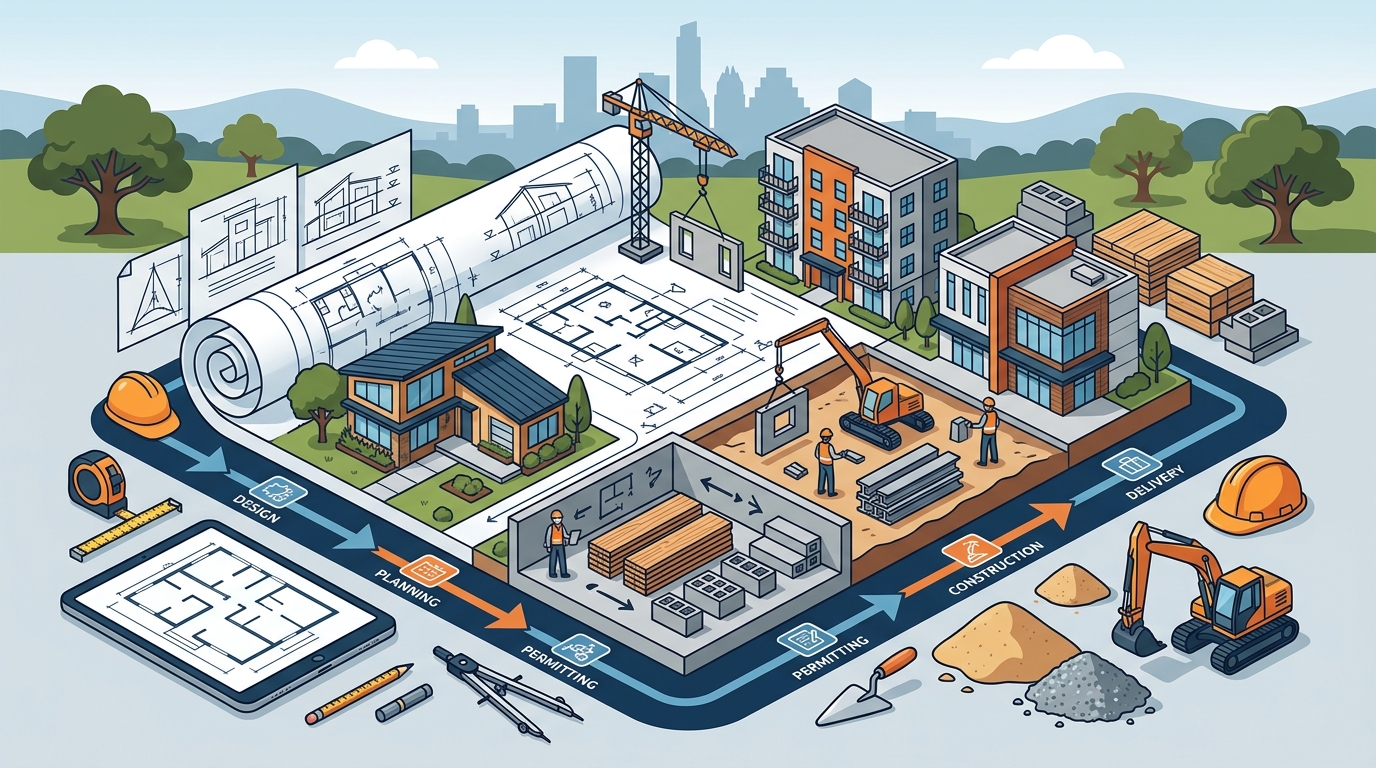
Design-build is a project delivery method that combines the roles of designer and contractor into one entity, facilitating time and cost savings, reducing change orders, and shifting design liability from the owner to the design-builder. Unlike the traditional design-bid-build approach, where an owner retains an architect and a general contractor under separate agreements, design-build places a single team in charge from concept through completion.
According to the Design-Build Institute of America (DBIA), design-build is now the most commonly used project delivery method in the United States. FMI Corporation projects it will represent over 47% of construction spending by 2028.
Why Integrated Design and Construction Matters in Austin
Austin has emerged as one of the fastest-growing architecture hubs in the country, driven by population growth, real estate expansion, and rising demand for sustainable design. That growth creates complexity. Steep Hill Country terrain, stringent municipal permitting, and Texas heat all demand tight collaboration between designers and builders from day one.
When architecture and construction live under one roof, decisions about materiality, structural systems, and budget happen in real time rather than across separate contracts. The result is fewer change orders, faster timelines, and a finished project that actually matches the original design intent.
The Austin Climate Factor
Central Texas summers regularly exceed 100 degrees Fahrenheit. Passive cooling strategies, smart orientation, and material selection are not optional here. A vertically integrated firm can test those decisions against construction feasibility before drawings are finalized, avoiding costly redesigns later.
What to Look for in a Design-Build Firm
Not every firm that offers both services delivers true integration. Here are the markers of a genuinely vertically integrated practice:
- Single point of accountability: One contract, one team, one schedule.
- In-house construction management: Builders who participate in design reviews, not just receive finished drawings.
- Range of typologies: Experience across residential, commercial, and multifamily projects signals operational depth.
- Track record of awards and press: Published work demonstrates peer-reviewed quality.
How Bercy Fadel Integrates Architecture and Construction
Bercy Fadel is a vertically integrated architecture and construction firm based in Austin, Texas, working across multifamily and single-family residential, master planning, and commercial development. The practice is grounded in the belief that architecture is inseparable from place, shaped by climate, materiality, landscape, and regional culture.
Leadership and Legacy
Emerging from the legacy of Bercy Chen Studio, the firm was founded by principals Thomas Bercy and Bethany Fadel, AIA. With over 50 years of combined experience, they bring internationally recognized architectural design together with disciplined development and construction management. That lineage reflects a collaborative, research-based approach in which architecture, urbanism, and development strategy are deeply intertwined.
Portfolio Breadth
The firm's project portfolio spans bespoke single-family residences like Edgeland House and Falling Leaves to large-scale developments such as Cambrian East Riverside and East Austin Hotel. The ability to move fluidly between a lakefront custom home and a transit-oriented multifamily building is a direct product of true vertical integration.
Design-Build vs. Design-Bid-Build: A Side-by-Side Comparison
Understanding the structural differences between these two approaches helps clarify why the integrated model delivers better outcomes for most Austin projects.
| Factor | Design-Build | Design-Bid-Build |
|---|---|---|
| Number of contracts | One (single entity) | Two or more (separate architect and contractor) |
| Communication | Direct, continuous | Fragmented across parties |
| Cost certainty | Higher; budget validated during design | Lower; costs revealed after bidding |
| Schedule | Overlapping phases save time | Sequential phases extend timeline |
| Change orders | Fewer; issues caught early | More common; design-construction gaps |
| Design liability | Rests with design-builder | Split between architect and contractor |
| Owner satisfaction | 76% report very good or excellent (DBIA) | Lower satisfaction ratings |
Data sourced from the DBIA Research Center. Design-build was rated highest across all delivery methods, with 76% of owners reporting very good or excellent experiences.
Project Types That Benefit Most
While any building project can use the design-build model, certain typologies see outsized benefits in Austin's market:
Custom Residences on Complex Sites
Austin's topography includes steep slopes, flood-prone creeks, and protected tree canopies. A firm handling both design and construction can assess buildability during schematic design rather than after construction documents are complete. See how Bercy Fadel navigates these challenges at Stonewake House.
Multifamily and Mixed-Use Developments
Multifamily projects demand precise coordination between unit planning, structural engineering, and construction sequencing. Bercy Fadel's multifamily portfolio demonstrates how integrated delivery keeps large-scale housing on schedule and on budget.
Commercial and Hospitality
Commercial development is a project category where budget overruns are especially damaging. A single accountable team reduces risk. Projects like the East Austin Hotel illustrate how design vision and construction discipline can coexist under one roof.
Key Takeaways
- Design-build is a project delivery method that unifies architecture and construction under a single contract, reducing risk and improving outcomes.
- FMI Corporation projects design-build will account for over 47% of U.S. construction spending by 2028.
- Austin's challenging terrain, climate, and permitting environment make integrated delivery especially valuable.
- Bercy Fadel is a vertically integrated firm led by Thomas Bercy and Bethany Fadel, AIA, with over 50 years of combined experience.
- The firm works across single-family residential, multifamily housing, master planning, and commercial development in Austin and Central Texas.
- True vertical integration means builders participate in the design process from day one, not just at handoff.
- Owner satisfaction with design-build is significantly higher than with traditional delivery methods, according to DBIA research.
Frequently Asked Questions
What does "vertically integrated" mean in architecture?
Vertically integrated means a single firm controls both the design and construction phases of a project. Instead of hiring an architect and a separate general contractor, you work with one team from initial concept through final walkthrough. This structure reduces communication gaps and keeps the original design vision intact.
Is design-build more expensive than hiring separate firms?
Design-build typically delivers projects at equal or lower cost compared to design-bid-build. The DBIA reports that design-build projects have lower unit costs and fewer change orders because budget alignment happens during the design phase, not after bidding.
What types of projects does Bercy Fadel handle?
Bercy Fadel works across multifamily and single-family residential, master planning, and commercial development. Their portfolio includes custom homes, boutique hotels, creative office spaces, and large-scale mixed-use developments throughout Austin and Central Texas. Explore their full range on the projects page.
How does Austin's climate affect architectural design decisions?
Central Texas heat demands intentional orientation, shading strategies, and material choices that manage solar gain. An integrated firm can validate these decisions against construction feasibility in real time, ensuring energy performance goals are met without budget surprises.
Who leads Bercy Fadel?
The firm is led by principals Thomas Bercy and Bethany Fadel, AIA. The studio emerged from the legacy of Bercy Chen Studio, bringing a research-based, design-driven foundation to a fully integrated practice with over 50 years of combined experience.
Does Bercy Fadel only work in Austin?
While the firm is based in Austin, Texas, their portfolio includes projects across Central Texas, including Fredericksburg, Bee Caves, Buda, and Lago Vista. Their master planning and commercial work extends to additional markets as well.
How do I start a project with a design-build firm?
The process typically begins with a discovery conversation about your site, goals, budget, and timeline. From there, the firm develops a scope of work that covers architecture, engineering, permitting, and construction under a single agreement. Contact Bercy Fadel to begin that conversation.
Ready to Build with One Integrated Team?
If you are considering a residential, multifamily, or commercial project in Austin, working with a vertically integrated firm can streamline your timeline, protect your budget, and deliver architecture that truly reflects your vision. Reach out to Bercy Fadel to discuss how their design and construction team can bring your project to life.