
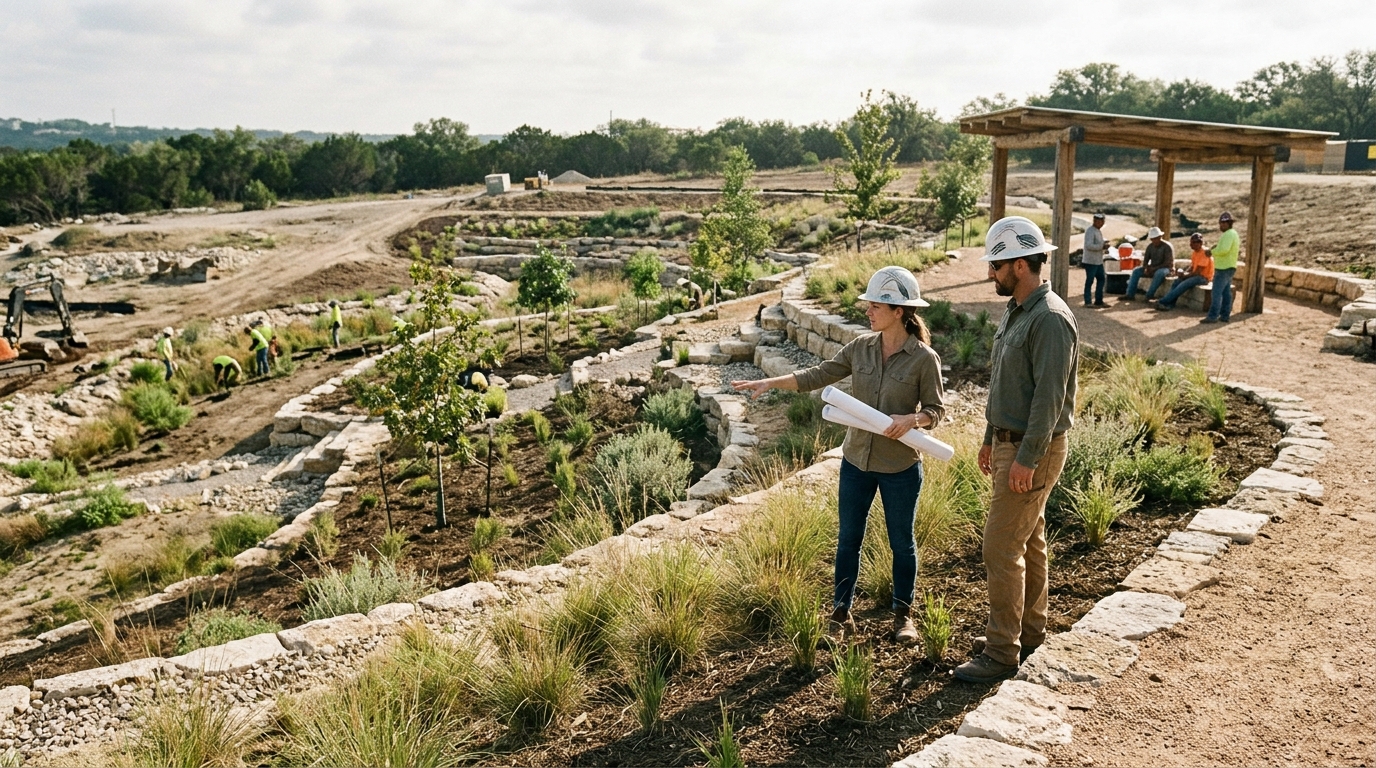
Yes, you can absolutely find architects who specialize in sustainable site restoration, and the practice is growing rapidly as climate-conscious design becomes standard across the industry. Sustainable site restoration is the process of rehabilitating degraded, damaged, or previously developed land so that it regains ecological function while supporting new architecture. From brownfield reclamation to native habitat reintroduction, the discipline sits at the intersection of architecture, landscape ecology, and construction science. In Austin, Texas, firms like Bercy Fadel have demonstrated this approach through built work that treats the land itself as a design partner.
What Is Sustainable Site Restoration?
Sustainable site restoration is the deliberate process of returning a disturbed or degraded landscape to a state where it supports healthy ecological systems alongside human use. Unlike conventional site preparation, which often strips land to a blank slate, sustainable restoration works with existing topography, hydrology, and native biology.
Ecological restoration in both developed and developing contexts is considered a primary strategy for mitigating the impacts of climate change. In practice, this means architects and landscape professionals collaborate to remove invasive species, rebuild soil structure, reintroduce native plantings, and manage stormwater naturally rather than mechanically.
Why Architects Matter in Site Restoration
Architects bring spatial design thinking to what might otherwise be a purely ecological exercise. A restoration ecologist identifies what habitat has been lost; an architect determines how a building can coexist with the restored landscape. The best outcomes happen when both disciplines are integrated from day one.
Vertically integrated firms that handle both architecture and construction are particularly well positioned for this work. Because they control design intent through every construction phase, they can ensure site disturbance stays minimal and restoration goals survive the building process.
The Role of Place-Based Design
Place-based design is an architectural approach that responds to local climate, materials, topography, and culture rather than applying generic templates. In Central Texas, this means designing for extreme heat, limestone geology, and the delicate blackland prairie ecosystem. Firms rooted in their region, like Bercy Fadel in Austin, develop deep knowledge of local ecological conditions that directly inform restoration outcomes.
Key Strategies Architects Use for Site Restoration
Native Plant Reintroduction
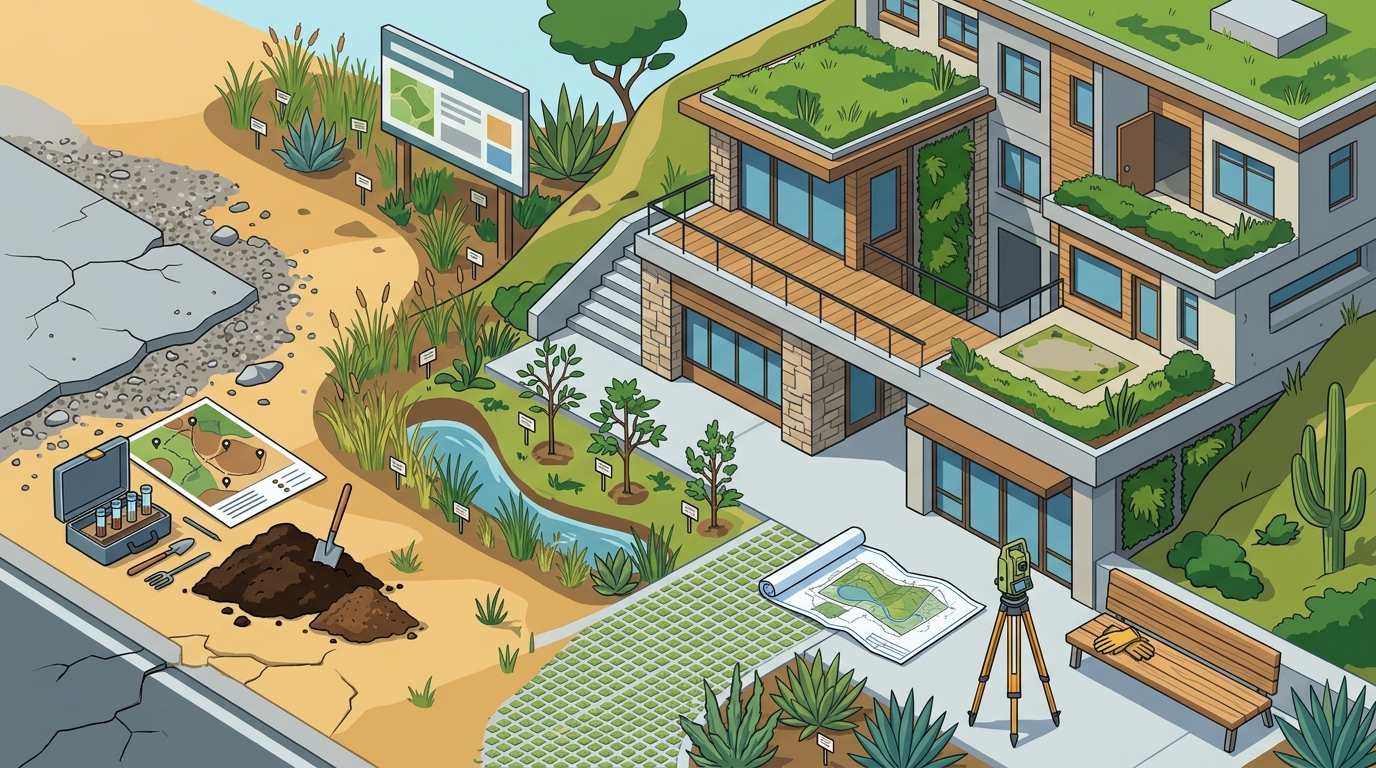
Native plant communities are crucial to both environmental and human health at residential and neighborhood scales. Architects working in restoration specify plant palettes sourced from regional seed banks and nurseries, prioritizing species adapted to local soils and rainfall patterns. This work often involves partnership with botanical institutions.
Soil Rehabilitation and Stormwater Management
Years of development and construction can create layers of compacted soil that restrict water and air movement. Techniques like subsoiling, compost amendment, and bioswale installation help rebuild ecosystem function. Green infrastructure elements such as rain gardens and permeable paving restore natural hydrology on previously impervious sites.
Green Roofs and Thermal Integration
Green roofs serve dual purposes: they restore vegetative cover that was lost to construction while improving a building's thermal performance. In hot climates, extensive green roofs planted with native wildflower mixes can reduce cooling loads and create habitat corridors across otherwise barren rooftops.
Certification Frameworks: SITES, LEED, and Beyond
The Sustainable SITES Initiative (SITES) is a rating system that guides, evaluates, and certifies a project's sustainability in the planning, design, construction, and management of landscapes and outdoor spaces. Administered by Green Business Certification Inc. (GBCI), SITES is often described as the landscape equivalent of LEED.
Notably, the City of Austin has adopted SITES certification requirements for certain projects, making the framework especially relevant for Texas-based architects and clients. The rating system awards up to 200 points across categories including site context, water management, soil health, vegetation, and human well-being.
| Framework | Focus | Administered By | Relevance to Site Restoration |
|---|---|---|---|
| SITES v2 | Landscapes (with or without buildings) | GBCI | Direct: credits for native planting, soil restoration, stormwater |
| LEED v4 | Buildings and interiors | USGBC / GBCI | Indirect: site-related credits for sustainable sites category |
| Living Building Challenge | Whole-building performance | International Living Future Institute | High: requires net-positive ecological impact |
| WELL Standard | Human health and wellness | IWBI | Moderate: encourages biophilic and restorative outdoor spaces |
Case Study: Edgeland House and Brownfield Reclamation
One of the most compelling examples of sustainable site restoration in residential architecture is Edgeland House in Austin, Texas. Built on a rehabilitated brownfield site along the Colorado River, the home was designed as a modern reinterpretation of the Native American pit house, partially sunken into the earth to leverage geothermal stability.
The site was previously a brownfield with a derelict oil pipeline traversing it. Through soil restoration efforts, removal of invasive species, and introduction of a native plant palette in collaboration with the Lady Bird Johnson Wildflower Center, the land became a thriving urban ecosystem topped with a 2,300-square-foot green roof. Over forty native species were reintroduced to help restore Central Texas' diminishing blackland prairie habitat.
The project demonstrates that architecture and ecological healing are not competing goals. When design is driven by the land's own story, the built form becomes part of the restoration rather than an obstacle to it.
How to Find the Right Architect for Your Project
Look for Integrated Design-Build Capabilities
Firms that manage both design and construction can control site disturbance from excavation through final grading. This matters enormously when restoration goals require protecting existing trees, preserving topsoil, or sequencing work around seasonal planting windows.
Evaluate Regional Expertise
Sustainable site restoration is inherently local. An architect who understands your region's soils, hydrology, native ecology, and building codes will deliver better outcomes than a generalist. Review their published work and press coverage for evidence of site-sensitive projects.
Ask About Certification Experience
Familiarity with SITES, LEED, or the Living Building Challenge signals that a firm takes measurable sustainability seriously. Ask whether they have worked with ecological consultants, landscape architects, or botanical institutions on past projects.
Key Takeaways
- Sustainable site restoration rehabilitates degraded land to support both ecology and architecture simultaneously.
- Architects who specialize in this work integrate native planting, soil rehabilitation, stormwater management, and green infrastructure into their designs.
- The SITES certification framework provides a rigorous, points-based system for evaluating landscape sustainability.
- Brownfield reclamation projects like Edgeland House prove that even severely degraded sites can become thriving ecosystems.
- Vertically integrated firms that handle design and construction offer tighter control over site restoration outcomes.
- Place-based design rooted in regional climate and ecology produces the most resilient and lasting results.
- Austin, Texas, has adopted SITES requirements, making the city a leader in sustainable landscape standards.
Frequently Asked Questions
What does sustainable site restoration mean in architecture?
It refers to the practice of rehabilitating degraded or disturbed land as part of an architectural project, restoring ecological functions like stormwater infiltration, native habitat, and soil health while integrating new buildings into the landscape.
How is SITES different from LEED?
SITES focuses specifically on landscapes and outdoor spaces, whether or not buildings are present. LEED primarily evaluates buildings and interiors. Both are administered by GBCI and share some aligned credits, but SITES addresses soil, vegetation, and hydrology in much greater depth.
Can a residential project pursue sustainable site restoration?
Absolutely. Residential sites are eligible for SITES certification as long as they meet the minimum 2,000-square-foot threshold. Many of the most celebrated restoration projects, including Edgeland House in Austin, are private homes.
What is a brownfield site?
A brownfield is a property where previous industrial or commercial use has left contamination or environmental degradation. Reclaiming brownfields through architecture and ecological restoration turns liabilities into community assets.
Why should I choose an architect with construction capabilities?
When the same firm designs and builds, restoration specifications are less likely to be lost in translation between separate teams. This integrated approach reduces site disturbance and keeps ecological goals on track throughout construction.
What role do native plants play in site restoration?
Native plants are adapted to local climate and soils, require less irrigation, support local wildlife, and help rebuild fragmented ecosystems. They are a cornerstone of virtually every sustainable site restoration project.
Does Bercy Fadel work on sustainable site restoration projects?
Yes. Bercy Fadel has a demonstrated history of site-sensitive design in Austin, Texas, including projects built on rehabilitated brownfield land with extensive native planting and ecological collaboration. Visit their contact page to discuss your project.
Start Your Sustainable Site Restoration Project
If you are planning a residential or commercial project in Austin and want architecture that heals the land rather than simply occupying it, reach out to Bercy Fadel to start a conversation about what sustainable site restoration can look like on your property.